Have you been injured in an accident while working aboard a vessel? The Jones Act entitles you to seek compensation for the damages resulting from your work-related injuries. However, to collect this compensation you’ll first have to prove that you qualify as a “seaman” under the Jones Act.
To qualify as a Jones Act seaman, a maritime worker must spend at least 30% of their working time contributing to the mission of a vessel in navigation, with a connection that is substantial in both duration and nature — the standard established by the U.S. Supreme Court in Chandris, Inc. v. Latsis, 515 U.S. 347 (1995).
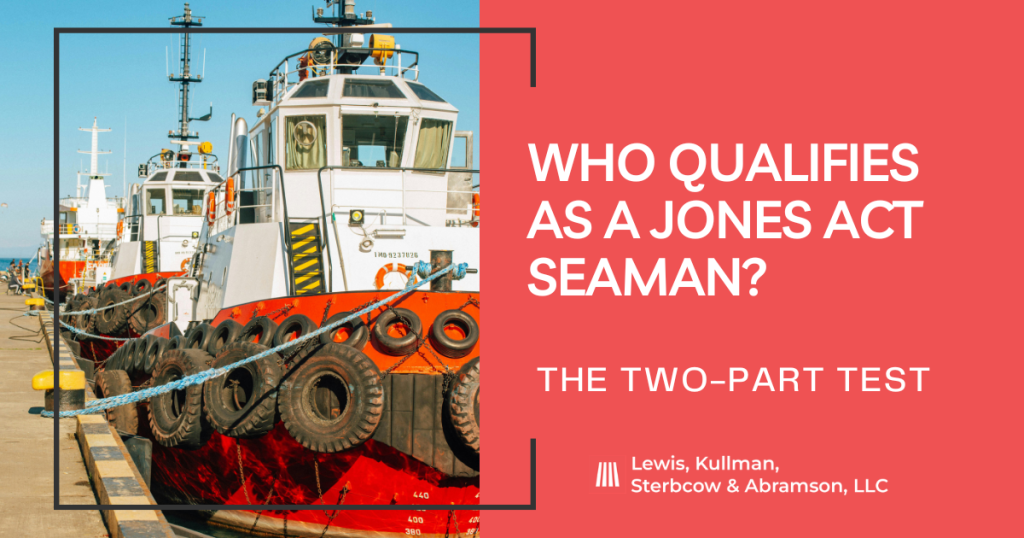
The Jones Act: Federal Protections for Injured Seamen
The Jones Act — codified at 46 U.S.C. § 30104 — gives qualifying maritime workers the right to sue their employers for negligence after a work-related injury, including recovery for medical expenses, lost wages, pain and suffering, and punitive damages where applicable.
Who Qualifies as a Jones Act Seaman? The Two-Part Test
Only a “seaman” is able to bring a Jones Act claim. To qualify as a seaman under the Jones Act, a maritime worker must meet certain criteria:
- You were employed on a vessel or fleet of vessels in navigation,
- You contributed to the mission or purpose of the vessel or group of vessels, and
- Your connection to the vessel or group of vessels was substantial in terms of both duration and nature.
Determining if you qualify as a seaman can be confusing and often requires analysis by an experienced maritime and admiralty law practice.
1: Your Work Must Contribute to the Vessel’s Mission
Almost any type of work performed aboard a vessel in navigation contributes to the mission or operation of that vessel in some way. However, recent court developments require that the worker be in engaged in sea-based or seagoing activity.
2: What Counts as a “Vessel” Under the Jones Act?
A vessel is any type of watercraft or contrivance used or capable or being used as a means of transportation on water. The definition of a vessel is not limited to traditional ships and boats. It can include other types of watercraft or artificial contrivance used, or capable of being practically used, as a means of transportation on navigable waters.
Read our detailed guide to what counts as a vessel under the Jones Act.
What Are “Navigable Waters”?
Navigable waters are any waters that are capable of being navigated for commerce and to which federal admiralty jurisdiction applies. This not only includes the open seas and intercoastal waterways bordering the U.S., but also any inland waterways that are used for commerce, such as rivers, lakes, and canals.
The 30% Rule: How Much Time Must You Spend on a Vessel?
“Substantial” is a broad term. Generally, in order to qualify as a Jones Act seaman, the worker must spend at least 30% of their total employment time contributing to the mission or operation of a vessel or group of vessels and be engaged in sea-based or seagoing activity.
This standard was established by the U.S. Supreme Court in Chandris, Inc. v. Latsis, 515 U.S. 347 (1995), which remains the controlling authority on Jones Act seaman status in federal courts including the Fifth Circuit.
The Fifth Circuit further refined this standard in Sanchez v. Smart Fabricators of Texas (2021), holding that a land-based welder sent to perform discrete short-term repair work on vessels did not qualify as a seaman. The court established that courts should ask: does the worker owe allegiance to the vessel rather than a shoreside employer, and is the work sea-based or does it involve seagoing activity? Temporary, task-based vessel assignments generally will not qualify.
The Most Recent Fifth Circuit Decision: Santee v. Oceaneering (2024)
The Fifth Circuit revisited seaman status again in Santee v. Oceaneering International, Inc., 110 F.4th 800 (5th Cir. 2024), applying the Sanchez framework to an ROV technician who worked on a drillship in the Gulf of Mexico. On rehearing, the court found the worker had a genuine possibility of proving seaman status — his work was sea-based, he was exposed to the perils of the sea, and his assignments were not limited to a single discrete task.
The contrast between Sanchez and Santee illustrates how courts apply the test in practice:
The key question is not simply whether you were on a vessel when you were injured — it’s whether your overall employment was vessel-based, ongoing, and exposed you to the realities of life at sea.
Which Workers Typically Qualify — and Which Don’t
Typically qualify as Jones Act seamen:
Typically do not qualify:
Not Sure If You Qualify? Get a Free Case Review
If you’ve been injured while working aboard a vessel, the Jones Act gives you the right to seek compensation for the damages caused by your injuries, including current and anticipated medical expenses, lost wages and employment, pain, suffering, and more. If you have questions about how to file a Jones Act claim or if you meet the qualifications for being a seaman under the Jones Act, give the New Orleans maritime attorneys at Lewis, Kullman, Sterbcow & Abramson, LLC a call.
LKSA has represented maritime workers in federal courts throughout the Gulf Coast for over 35 years. Our attorneys have played a defining role in cases that shaped Jones Act seaman status law in the Eastern District of Louisiana. Paul Sterbcow served as Co-Lead Trial Counsel in the Deepwater Horizon liability trial; Ian Taylor was appointed to the Executive Committee in the SEACOR Power litigation.
Some of our Jones Act/general maritime law case verdicts include:
- A $1,700,000 settlement for severe injuries caused by an explosion and fire aboard a vessel. (Settlement, Gulf Coast maritime litigation)
- A $2,757,008 jury award for a rig crew member who suffered an arm-crushing injury. (Jury verdict, United States District Court, Eastern District of Louisiana)
- A $1,139,828, judge award (including $150,000 in punitive damages and attorney fees) for a leg and cervical spine injury caused by another crewmember. (Judicial award, Eastern District of Louisiana)
You only have a limited time in which to file a Jones Act claim. If you wait too long, the courts may refuse to hear your case. Contact the law offices of Lewis, Kullman, Sterbcow & Abramson, LLC through our website, or call us at (504) 588-1500 as soon as possible after your accident to schedule a free initial consultation with a highly experienced Jones Act attorney. We are headquartered in New Orleans, Louisiana, but serve clients all over the Gulf Coast and across the U.S.